

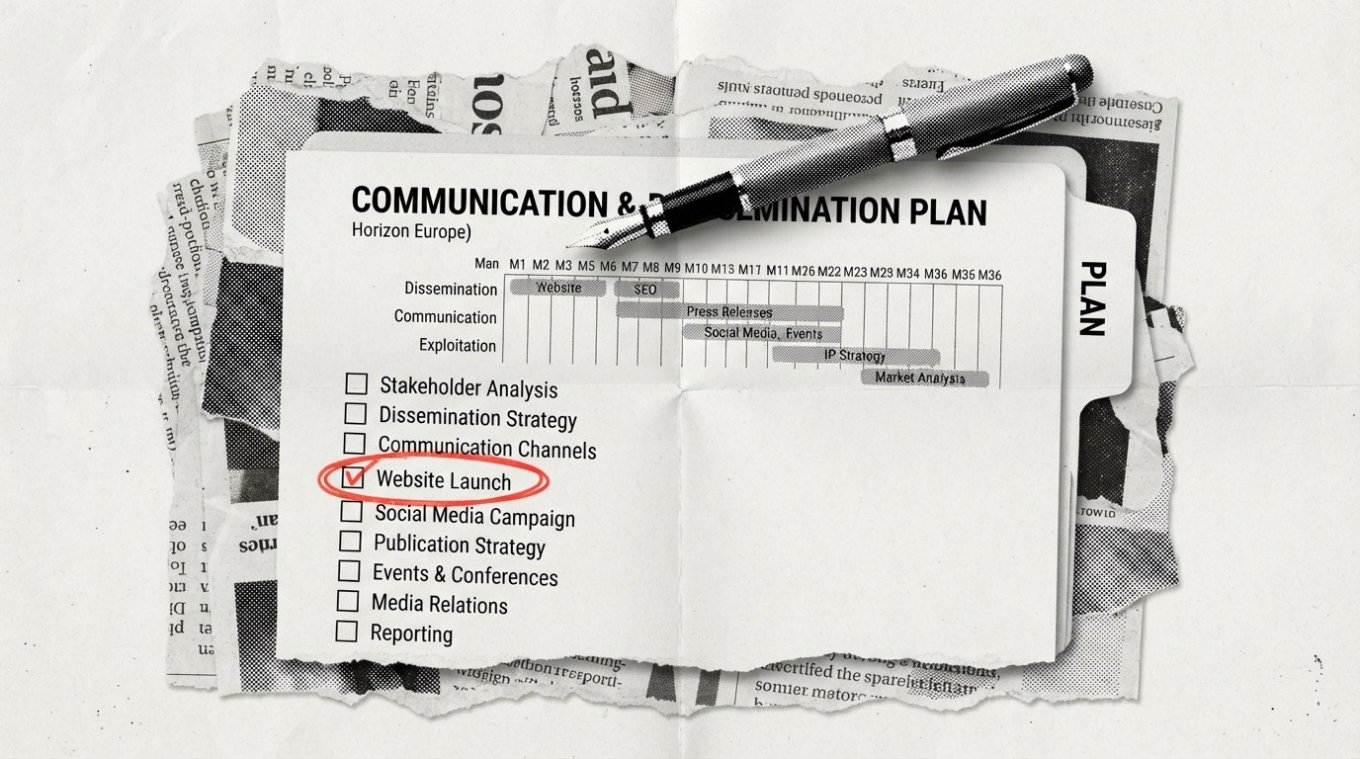
In any Horizon Europe proposal, the communication and dissemination plan is scored during the evaluation — and yet many proposals treat it as a formality written on the last night. It's a missed opportunity: a concrete and credible plan weighs in the score at Impact and differentiates you from consortia that deliver generalities. Here's what a plan that passes evaluation and then works in practice looks like.
Where does the plan appear in the proposal?
The communication and dissemination plan does not sit in a separate corner: it is part of the Impact of the proposal and is often embodied in a dedicated work package or in clear activities with responsibilities and resources. Evaluators score the communication plan and the dissemination & exploitation plan separately, so both need to be visible and well-constructed — not melted into a vague paragraph.
What a good plan contains
A solid communication and dissemination plan covers, for each dimension, the following:
- objection — what you want to achieve (notoriety, knowledge transfer, takeover of results), not "let's communicate the project".
- Target audience — mapped by categories (general public, scientific community, industry, decision-makers), because each requires a different message and channel.
- Key messages — what exactly do you say to each audience?.
- Channels and activities — suitable for each audience: press and social media for communication; publications, conferences, materials for partners and policy briefs for dissemination.
- Calendar — communication starts with the project, not at the end; dissemination follows the pace of the results.
- Indicators (KPIs) — measurable and realistic, by which you demonstrate that the plan happened.
- Responsibilities and resources — who does it, with what budget and with what expertise.
Realistic indicators
KPIs are where you see whether a plan is serious or decorative. Some examples of indicators you can define and then report on:
| Size | Examples of indicators |
| Communication | number of press releases and media appearances; followers and engagement on project channels; participants in public events |
| Dissemination | peer-reviewed publications (open access); conference presentations; materials for partners; open datasets |
| exploitation | results taken up by users; contributions to policies or standards; products/services resulting from the project |
The rule is simple: set numbers that you can achieve and demonstrate. An inflated but unfulfilled indicator will ruin your reporting later.
Mistakes that lose points
- Treating communication and dissemination as the same thing — the most common confusions are explained here: Communication vs. Dissemination vs. Exploitation.
- A generic plan, without a clear target audience and without channels suitable for each audience.
- Vague or unmeasurable indicators ("we will increase visibility").
- Lack of a real person in charge and a budget for communication.
More traps, with examples, in 5 mistakes in research project communication.
The plan does not end upon submission.
A good plan written in the proposal is only half the battle. If the project is funded, the plan must be implemented throughout its duration — with press releases, events, publications and reporting to the Commission. That is why it is important that, even from the proposal stage, the plan is realistic: write what you can actually do, not what sounds good.
Frequently Asked Questions
What should a communication and dissemination plan for Horizon Europe contain?
A credible plan covers: clear objectives (not generic), target audience mapped by categories, messages adapted to each audience, appropriate channels, a realistic timeline, and measurable indicators (KPIs). Evaluators score the communication plan and the dissemination & exploitation plan separately — both must be visible and well-constructed in the proposal.
Where does the communication and dissemination plan appear in the Horizon Europe proposal?
It is part of the Impact section of the proposal and is often embodied in a dedicated work package, with activities, responsibilities, and resources. Evaluators look for it explicitly — a vague or formal plan lowers the Impact score, no matter how solid the scientific part.
What indicators (KPIs) are used for communication and dissemination in European projects?
For communication: media appearances, event attendees, followers on project channels. For dissemination: open access publications, conference presentations, downloaded datasets, partner materials. Rule: set targets that you can achieve and demonstrate — an inflated but unmet indicator hurts your mid-term reporting.
Official sources
- Horizon Europe Programme Guide (European Commission, PDF, EN)
- Communicating about your EU-funded project (REA, European Commission, EN)
- Horizon Europe: dissemination and exploitation (REA, European Commission, EN)
Do you need a partner in communication and dissemination?
I have written and implemented communication and dissemination plans for 7 European projects, with international experience in science communication. I can write the proposal chapter, be the appointed communication expert in the consortium or take over the execution throughout the project. See how can I help you or let's talk.


 English (UK)
  Română