

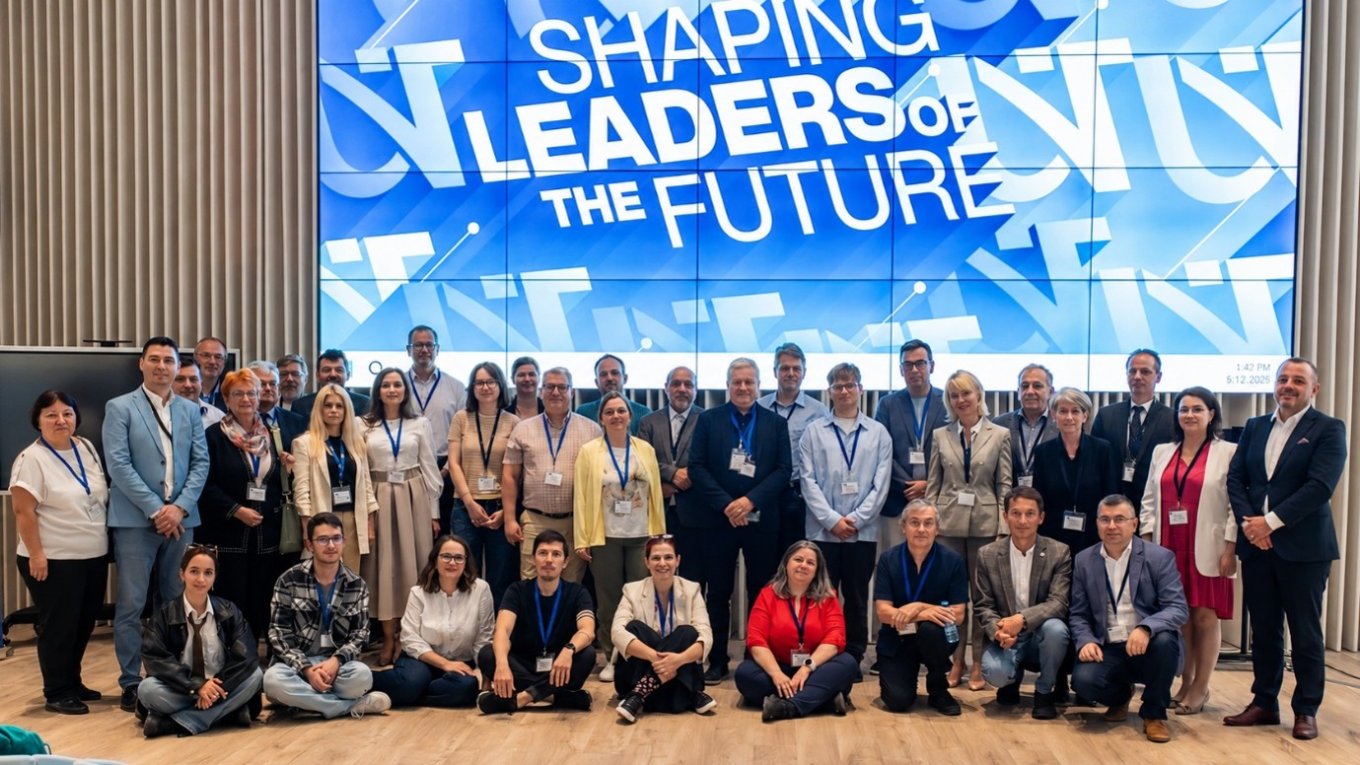
Over 50 researchers, science communicators and academic leadership representatives, from over 30 universities, research institutes and non-governmental organizations from all over the country, gathered in Timisoara and adopted a joint statement: the commitment to build, in every institution, systems dedicated to science communication — people, strategies and recognition, beyond individual initiatives so far.
The declaration was adopted in the context of the first National Science Communication Conferences, hosted by West University of Timisoara during the period June 12–13, 2026 — the first national framework in Romania dedicated to the role of communication in research. The event was organized under the aegis of UVT, in partnership with Sci Public Forum, Science and Communication and CeCOCe-VEST.
Science and Communication, among the organizers
I was part of the organizing team of this first edition, through the project Science and Communication. In my intervention I advocated for the transition from individual initiatives to a national strategy dedicated to the field: the professionalization of science communication needs systems in every institution, not just the enthusiasm of a few people. Communication is not an element added at the end of research, but an essential part of it.
What the Timișoara Declaration promises
Document adopted — memorandum „"Romanian research needs a stronger voice to be heard"” — does not remain at the level of principles. Through it, the representatives of the participating organizations express their willingness to introduce into the institutional agendas and strategies five concrete directions of action, intended to transform science communication from a peripheral activity into an organizationally assumed system:
- Dedicated staff and institutional strategy for science communication. Communicating research results cannot be left to individual enthusiasm: every organization needs a clear strategy, dedicated resources, and systematic collaboration between researchers and communication professionals, ensuring the balance between scientific rigor and accessibility.
- Official recognition of communication as a professional activity of the researcher. Researchers who participate in public debates and collaborate with the press currently do not receive formal recognition for this activity, although it has real costs. The declaration encourages the introduction of recognition and reward mechanisms in evaluation and career plans.
- Investing in developing communication skills. Communicating with the general public or journalists is a distinct skill, which is cultivated through specialized training — with an emphasis on media relations, public communication, and the translation of scientific knowledge for non-academic audiences.
- A proactive and transparent relationship with the press. Universities and research institutes are encouraged to build structured relationships with the press and facilitate journalists' access to verifiable and contextualized expertise.
- Science communication as a bridge between research and the private environment. Better communication of results facilitates the transfer of technology and knowledge to the private sector and, in turn, closer collaboration with the private sector increases the relevance of research and the quality of teaching.
The declaration is intended to be the first in a tradition: the organizers aim for the event to become a community of good practice, a space that is renewed and recalibrated year after year, as the field matures.
📄 Full statement
Download the memorandum adopted at the end of the conference: „"Romanian research needs a voice" (PDF).
Context: why such a commitment was needed
Romania allocates 0.46% of GDP for research and development (2024), compared to a European average of 2.26% and to the threshold of 3% assumed by the Lisbon Strategy. Hungary invests four times more than Romania, and the Czech Republic eight times, as a percentage of GDP.
Changing this situation depends on a sufficiently broad public understanding of the value of research — one that generates demand and political will. Science communication is the vector of this change: not an afterthought, but an essential part of research itself. Over the two days, participants discussed precisely this role, in a context where investment in research remains below the European average.
Source and details: West University of Timisoara. Photo: UVT.

 English (UK)
  Română