

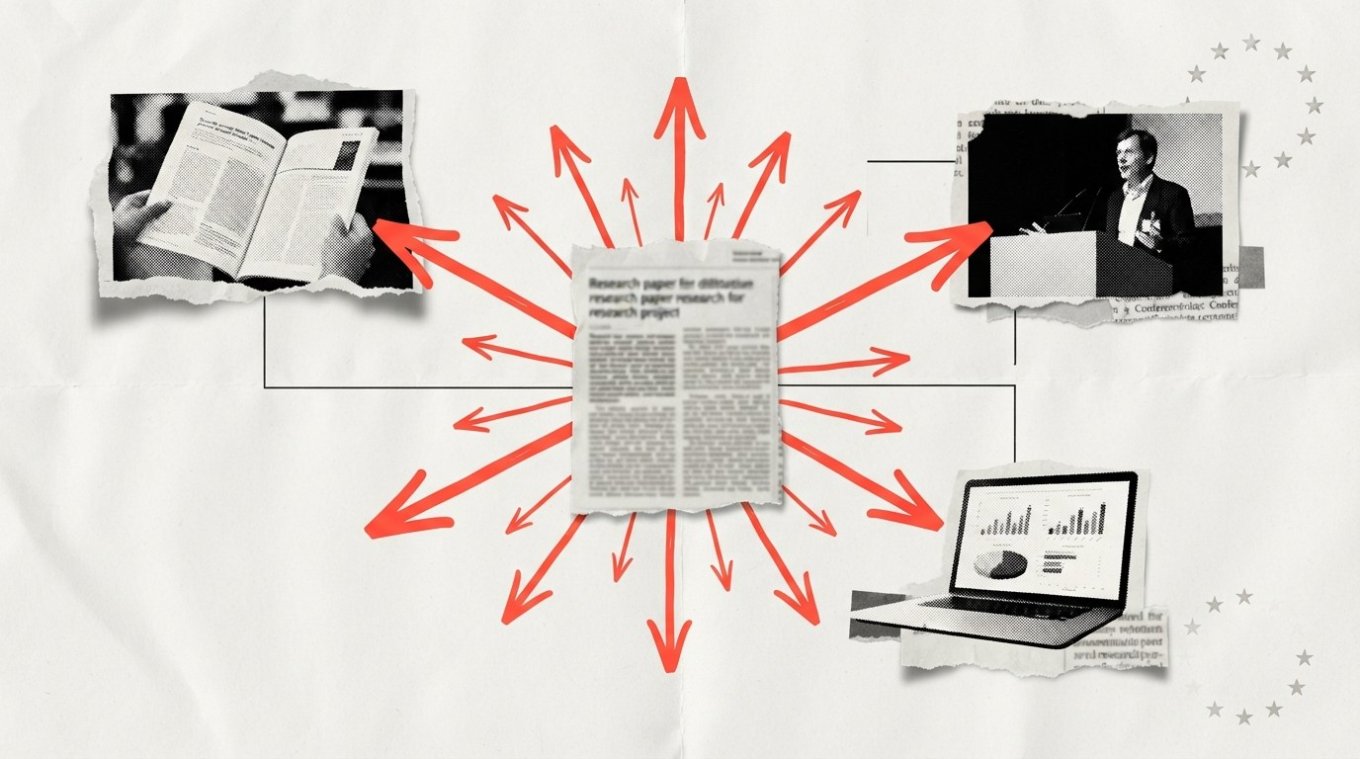
Dissemination is probably the most misunderstood term in European projects. It is confused with communication, treated as a formality, or reduced to „we publish an article and that’s it”. In reality, dissemination has a precise definition in Horizon Europe, a specific audience, and a clear place in the proposal — and evaluators score it separately. Here’s what it actually means and how to plan for it correctly.
What does dissemination actually mean?
In the language of the European Commission, dissemination „refers to the effort to make results known to those communities that can best use them, perhaps even beyond the initial idea of who might use the results.” In other words: you’re not talking to the general public (that’s communication), but to those who can take the results and take them further — other researchers, industry, policymakers, users. The goal is not visibility per se, but knowledge transfer: that your work be used.
Dissemination vs. communication vs. exploitation, in short
Horizon Europe requires three different things, with different audiences and objectives:
- Communication — to the general public and the press, about the project and its social relevance.
- Dissemination — to those who can use the results, for knowledge transfer.
- exploitation — the effective implementation of results (products, services, policies).
Confusion between them is one of the most common reasons why an otherwise good chapter loses points. I've explained the differences in detail, with the official definitions, here: Communication vs. Dissemination vs. Exploitation in Horizon Europe.
Who are you addressing through dissemination?
Unlike communication, which targets a general audience, dissemination has specialized audiences:
- The scientific community — other researchers who can build on your results.
- Industry and potential users — companies or organizations that can turn the results into applications.
- Decision makers — those who can use the results in public policies or standards.
- Other projects and networks — initiatives with similar themes, with whom you can exchange results.
A common mistake is to treat all these audiences the same. A message for an industry partner does not look like one for an academic research group — even if it starts from the same result.
Dissemination channels
- Peer-reviewed publications, preferably in the regime open access — the backbone of scientific dissemination.
- Conferences and workshops — for direct contact with the community.
- Repositories and open datasets — so that the results can be found and reused.
- Materials for partners — brochures, data sheets, presentations for potential industry users.
- Policy briefs — summaries for decision-makers.
- Project networks and clusters — dissemination "between projects" with related themes.
Open science: dissemination as an obligation
In Horizon Europe, open access to publications is no longer optional — it is a contractual obligation. The practices open science (open access to publications, responsible data management according to the FAIR principles) are part of the way a project is evaluated and monitored. Well-thought-out dissemination and open science obligations actually go in the same direction: for the results to be found, understood and used.
How do you plan dissemination in your proposal?
A credible dissemination plan is not a list of intentions ("we will publish articles and attend conferences"), but a concrete plan, with:
- Target audience clearly identified, by categories.
- channels suitable for each audience.
- Activities and calendar — what, when, who.
- Indicators (KPIs) realistic, showing that dissemination actually took place.
I detailed how to build it, step by step, in the article about how to write the communication and dissemination plan for a Horizon Europe proposal.
Frequently Asked Questions
What does dissemination mean in Horizon Europe?
Dissemination means making the project results known to the communities that can best use them — other researchers, industry, decision-makers. It is not the same as communication (which is addressed to the general public) or exploitation (which means putting the results into practice). It is defined by the European Commission and is scored separately in the evaluation.
What is the difference between dissemination and communication in Horizon Europe?
Communication targets the general public and the press — the goal is the social visibility of the project. Dissemination targets specialists and potential users of the results — the goal is knowledge transfer. The same project needs both, but with different messages and channels. Confusion between them is one of the most common reasons why an Impact chapter loses points.
What channels are used for dissemination?
The main dissemination channels are peer-reviewed open access publications, presentations at conferences and workshops, open data repositories and materials for industry partners or decision-makers (technical brochures, policy briefs). The choice of channel depends on the target audience: an industry-relevant result reaches them through something other than an article in an academic journal.
How do I plan dissemination in my Horizon Europe proposal?
A credible dissemination plan identifies target audiences by category, allocates appropriate channels to each audience, sets activities with a clear calendar, and defines measurable indicators (KPIs) that demonstrate that dissemination has taken place. Evaluators quickly recognize a generic plan from a specific one — the details on how to build the plan are in the dedicated article.
Official sources
- Horizon Europe Programme Guide (European Commission, PDF, EN)
- Horizon Europe: dissemination and exploitation (REA, European Commission, EN)
Do you need help with dissemination?
I have worked on the communication and dissemination of 7 European projects, from writing the proposal chapter to the execution throughout the project. If you are preparing a Horizon Europe proposal or implementing a project and need a dissemination partner, see how can I help you or let's talk.

 English (UK)
  Română