

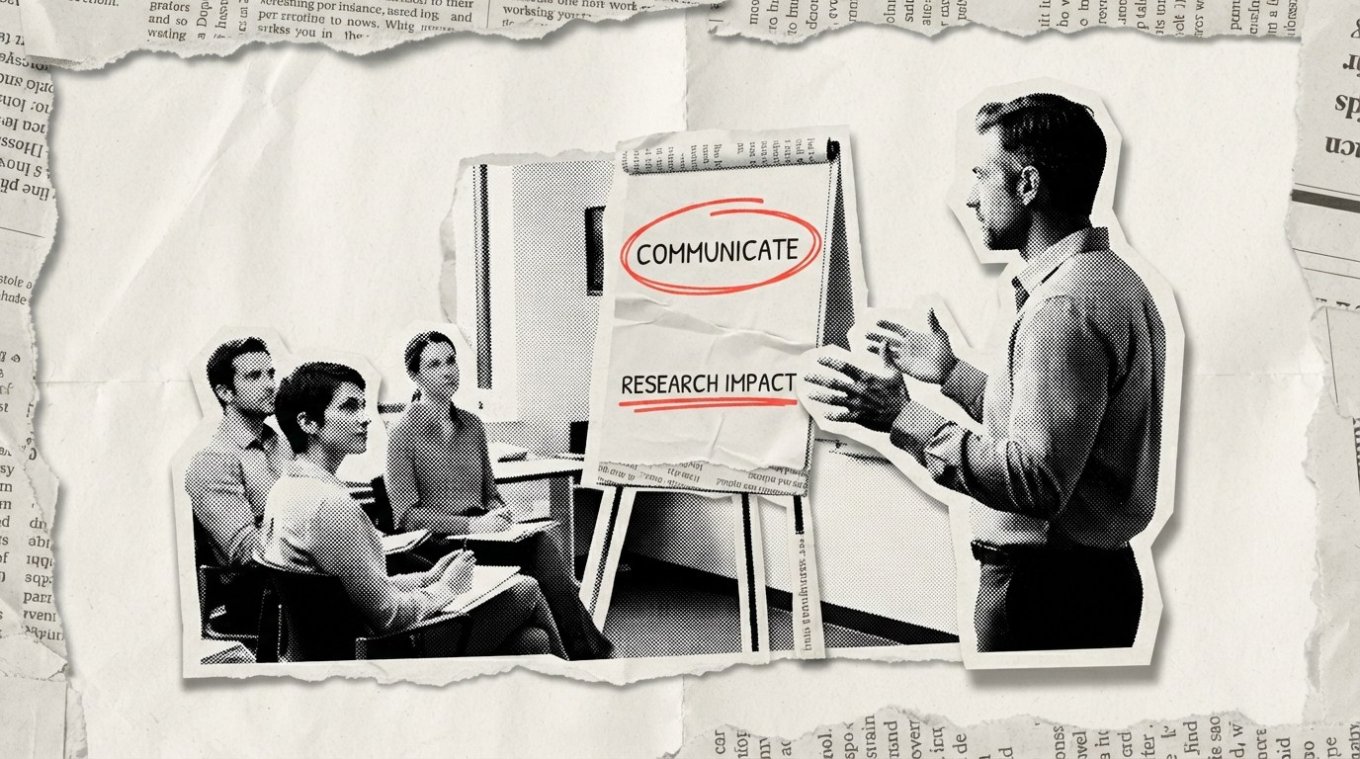
Many research departments do remarkable work that almost no one outside their own field knows about. Not because the results don’t matter, but because no one has ever been taught how to communicate them. Communication training is not a luxury or a „branding” expense — it’s how your work gets to the people, funders, and partners who matter.
The cost of silence
When a department's results remain invisible, the cost is not abstract. It is seen in very concrete things:
- On financing. European projects — from Horizon Europe on down — explicitly require a communication and dissemination plan, scored in the evaluation. A department that does not know how to communicate starts with a handicap in the competition for funds.
- In institutional evaluations. „"Public engagement" and impact on society have become criteria in more and more university evaluations and strategies. What cannot be shown cannot be scored.
- Attracting students and partners. A future PhD student, a company looking for a research partner, or a journalist looking for a source choose what they find and understand. Research that is not seen does not count.
- To the public's trust. In a world full of misinformation, the voice of researchers who honestly explain their work is one of the most valuable public resources. Silence leaves that to others.
In other words: communication is not something you do "after" the research is done. It is part of how the research produces its effect.
What changes after a training session?
Good training doesn't turn researchers into journalists. It gives them concrete tools they can use the next day:
- They can write a summary of their work that someone outside the field can understand—essential for grant applications, press releases, and the institution's website.
- I can talk to a journalist without fear of being misquoted, because I know how to prepare my messages.
- I know when and how to build a press release that actually gets into the press.
- I use social media and public presentations as tools, not as a chore.
- The institution's communications team gains clear workflows with researchers, instead of chasing information at the last minute.
It's not about talent, it's about method.
The most common objection is: „our researchers are not communicators.” The truth is, they don’t have to be. Scientific communication is not an innate gift, it’s a set of skills that are learned: how to identify the stakes of a result, how to say it simply without trivializing it, how to structure a message for a specific audience. Just like research methodology, it is taught and practiced. I have seen this in over 3,000 researchers and students who have gone through my trainings: the difference is not talent, but the fact that someone showed them, once, how to do it.
What does training that really works look like?
A useful communication training for a research department is not a general lecture on the "importance of communication". It is applied to the real work of the participants:
- They work on their results and projects, not on abstract examples.
- They practice — they write summaries, headlines, press releases, simulate interviews — not just listen.
- It adapts to real needs: a group preparing a Horizon Europe proposal needs something different than one that wants to be more visible in the local press.
- It ends with materials and flows that the team can use further, on its own.
The format can be a half-day or full-day workshop, online or on-site, for a research group or the entire department.
Why me?
I have been working for 20 years at the research table in Romania, as a science communicator with a double education — journalism and physics. I have held over 50 trainings, worked with 7 universities in the country and led communication on 7 European projects, with international experience in science communication. I have held trainings including for the European Geosciences Union community (over 30,000 members). I do not teach science communication from books — I practice it every day, including through the weekly newsletter Romanian Science Digest, which brings to light results from Romanian research.
Frequently Asked Questions
What is communication training for researchers?
A communication training for researchers is a practical program through which research teams learn to explain their work in an accessible way — to the press, funders, partners, or the general public. It doesn't turn researchers into journalists: it gives them concrete tools (how to write a summary, how to build a press release, how to manage an interview) that they can use the next day in their work.
Why does a research department need communication training?
European funding (Horizon Europe and others) explicitly requires communication and dissemination plans, scored in the evaluation. Institutional evaluations increasingly include criteria for impact on society. And research that is not visible does not attract students, partners or funders. Communication is not a luxury — it is part of the way research produces its effect.
What does communication training applied to research work look like?
We work on the participants' real results and projects, not on abstract examples. We practice — we write summaries, headlines, press releases, simulate interviews. The format adapts to the needs of the group: preparing a Horizon Europe proposal requires more than just visibility in the local press. The training ends with concrete materials that the team can use on its own.
How do we start?
If you are considering communication training for your department or research group, the first step is a brief discussion about what you need. We can build a program tailored to your needs from there. Let's talk. — or see first What do the trainings look like?.
- Communication and dissemination for Horizon Europe projects
- Guide: how to write a press release for research
 English (UK)
  Română