

I was going to see Marius Mihășan, a professor at Alexandru Ioan Cuza University, because I had heard that he was using 3D printed molecules with his students. More precisely, it was about a digital tool that he and his team had created to quickly generate 3D molecular models – the kind of software that saves you hours of manual work if you’re a chemist. Good topic, clear, useful. I knew what I wanted, I knew what I was asking, I knew what the article would look like.
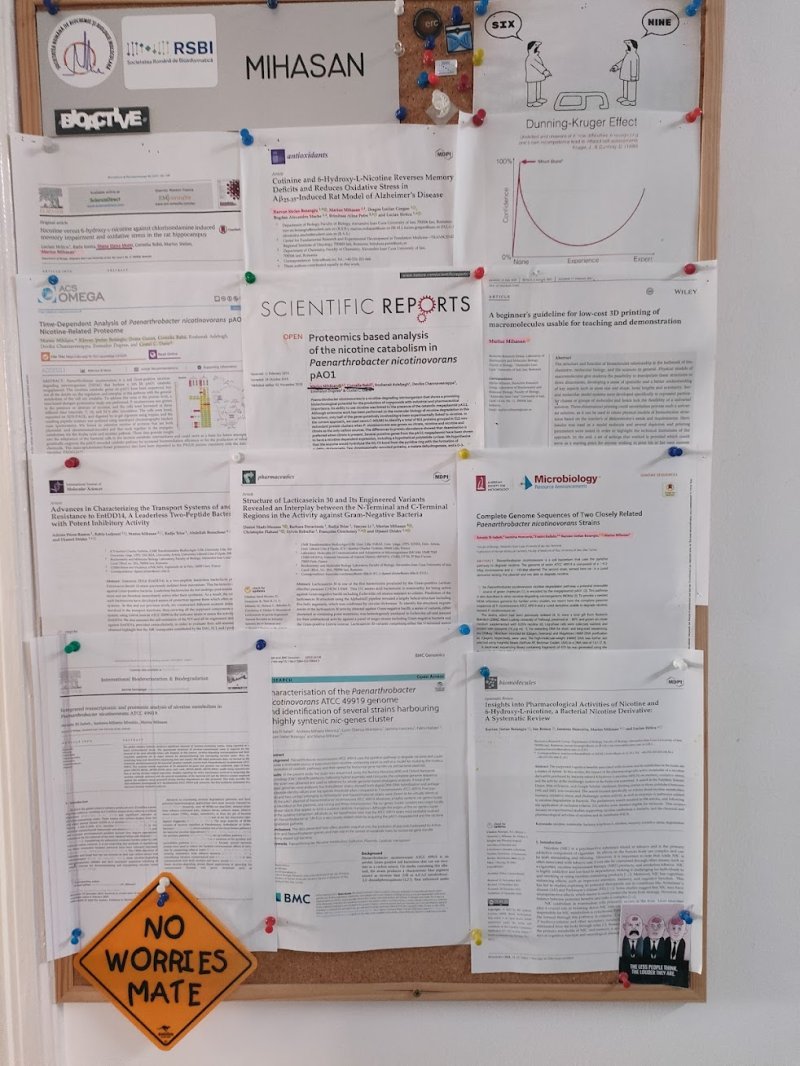
He waited for me at the entrance to the office and there I saw, pinned to a cork board, the real subject.
It was a scientific article about nicotine. I understood 20% from the words, so I asked my favorite question: "What is that?".
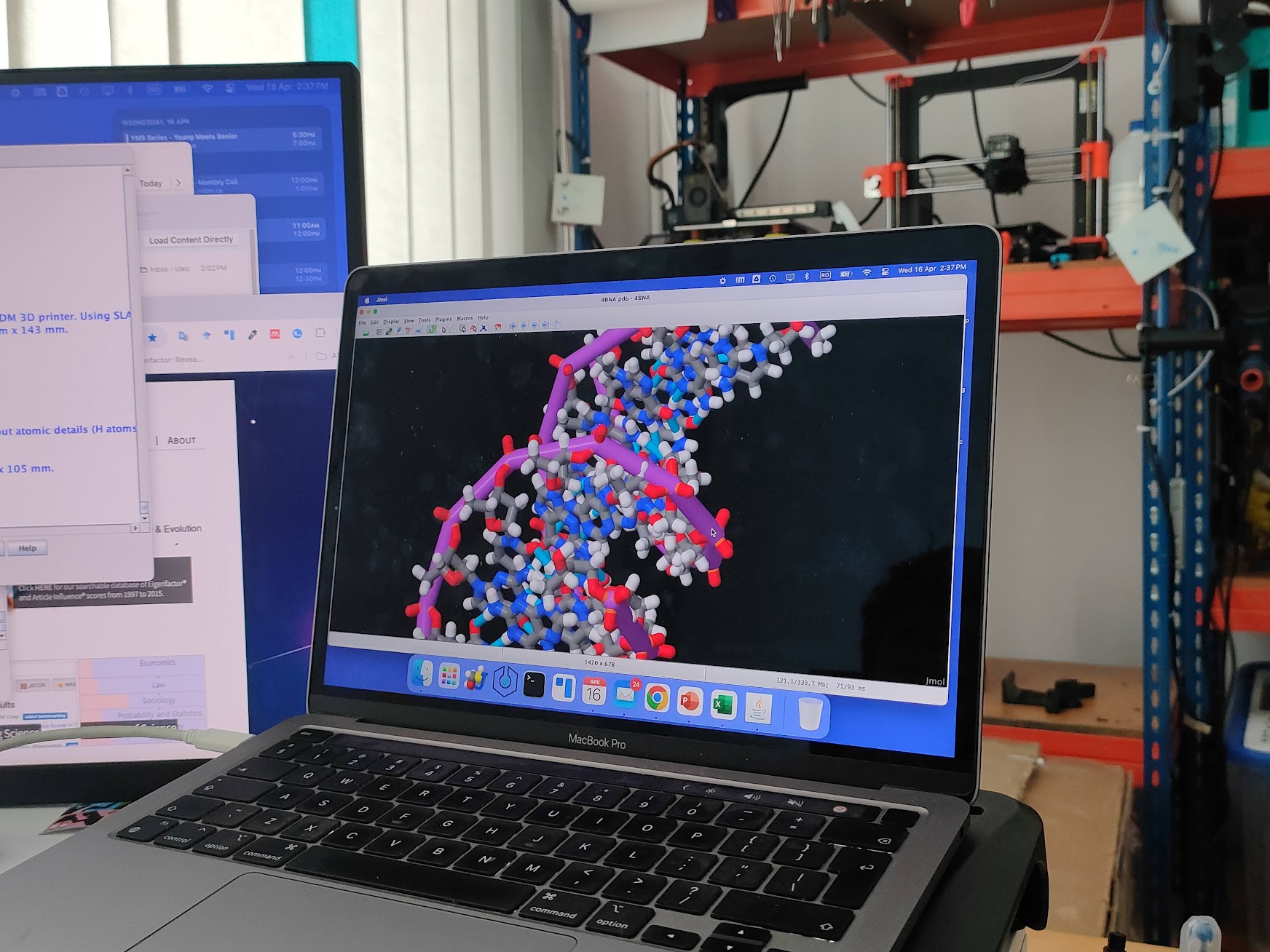
Marius didn't hesitate for a second and began to explain. His team was working with a soil bacterium that feeds on nicotine and transforms it into a compound with potential in treating Alzheimer's disease – starting from tobacco waste that you have to decontaminate anyway. They didn't have a treatment. They had a direction, a promising result from a lab in Iași, and a logic that was hard to ignore. The article is here.
I temporarily put aside my questions about 3D molecules and started listening to him with a different attention.
The more he talked, the more I realized that the topic on the panel was more interesting than the one I had come for. Not spectacular, not „curing Alzheimer’s” – but exactly the kind of serious Romanian research that rarely comes out of the laboratory: methodical, published in quality journals, built on solid logic. Tobacco waste, a waste product that Romania has in abundance, transformed into raw material for pharmaceutical research.
I stayed longer than I had planned. I asked questions I hadn't prepared. In the end, I had the material for an article I didn't know I was looking for.
I published it first. The one about 3D molecular models – the original topic, the reason for the visit – appeared half a year away.
I tell you this story to help you understand how deeply buried the impactful results of science remain. I work at Alexandru Ioan Cuza University, I spend a lot of time discovering which articles from researchers at the university have high communication potential, and sometimes I still miss interesting topics. This time, my method was the simplest tool at the disposal of a communicator – curiosity.
But it is not the only tool. In 2024, The Balkan Network of Science Journalists and the European Federation for Science Journalism launched From the Field. The Science Journalist's Guide – a 138-page guide created by over 20 journalists and content creators from Romania, coordinated by Andrada Fiscutean and Cristina Radu. I contributed a chapter on how to find topics in Romanian research.
Why I chose this topic for the chapter: Romanian research is not absent, it is hidden. Not because someone would intentionally hide it, but because the system is not built to make it visible. Universities publish announcements, laboratories post on hard-to-find websites, researchers write in journals that no one reads except specialists. If you don't know where to look – and how to look – you miss out.
That's why I decided to turn this chapter into a series on my website. This was the first. In the next four episodes I will explain how you can find interesting topics from Romanian research, how to find the right expert for any topic, and how to tell if a discovery that sounds good has real scientific basis.
But I wanted to start with the story from Marius Mihășan's office, because it illustrates something that no method can completely replace: staying curious even after you've gotten the answer you came for.
 English (UK)
  Română